Reading Small Groups are an essential component of the Reading Workshop; however, they can also be quite intimidating for some teachers. There are many factors to consider when planning for your reading small group instruction. Hopefully, these tips for creating a small group schedule will help make reading groups a bit less overwhelming for you!
This post is part of a series on Reading Small Groups. You may also be interested in reading these posts to find out more:
This post includes affiliate links for which I may make a small commission at no extra cost to you should you make a purchase.
Establishing Reading Small Groups
There are various ways to form your small groups. While there is no one size fits all approach, these tips will help you determine what works best for you and your students!
Assessment
Reading Small Groups should be based on data in order to make the most effective groupings and to help you plan more targeted instruction based on students’ needs. These reading assessments are not just administered at the beginning of the year. Instead, you should continue to use data to modify your reading small groups as necessary throughout the year based on students’ progress.
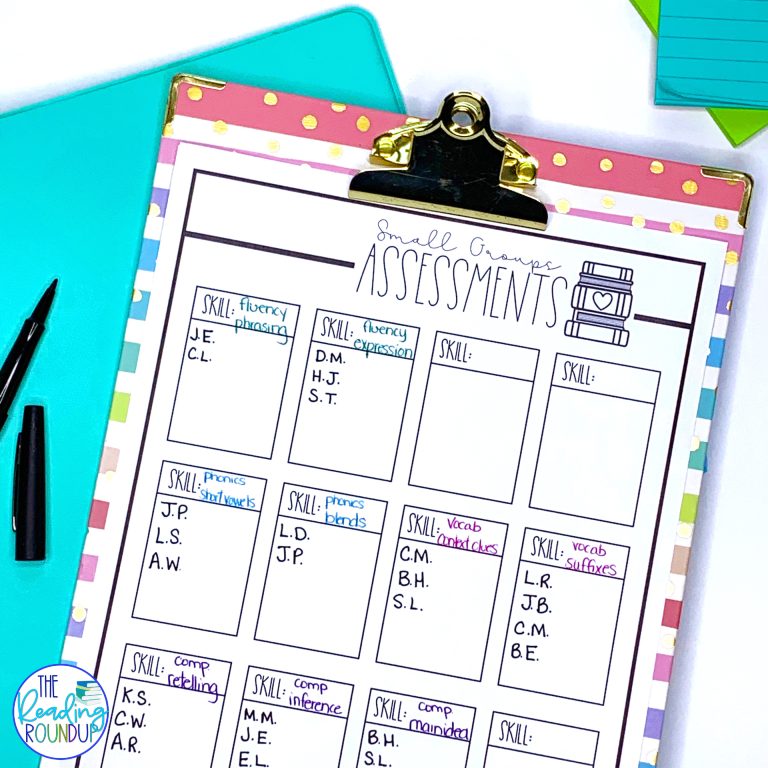

There are not specific assessments that you have to administer. You can use whatever assessments are already available at your school. They may include:
- Instructional Reading Level Assessments: Your school may measure students’ levels by DRA2, Fountas & Pinnell Guided Reading, Lexile, AR, or another type of reading level. If your school does not have these assessments, you can administer running records using leveled books to determine baseline data.
- Phonological Awareness Assessments: Determine students’ ability to segment and blend sounds, delete sounds, recognize rhyming words, and identify syllables.
- Spelling Inventories: Obtain additional insight into students’ phonemic awareness. Two commonly used spelling inventories are by Jan Richardson and Words Their Way.
- Benchmark and Baseline Assessments: Your school may utilize benchmark assessments to determine students’ comprehension, writing skills, sight word knowledge, and other skills.
- Computer Assessments: Some schools may use online diagnostic tests such as Istation, NWEA MAP Suite, or Star Assessments to determine students’ baseline data.
- Ongoing Progress Monitoring: Continue monitoring students’ progress throughout the year to reassess group placement. These assessments may include anecdotal notes, running records, reading/writing conference notes, unit tests, or writing samples.
Forming Reading Small Groups
Once you have collected data on your students, you can place them into groups. Reading small groups are created homogenously with students who have similar academic needs.

There are two types of groups you may form:
- Guided Reading Groups – These groups are based on students’ reading levels. While working with this type of group, students all use the same text to work on various reading, phonics, and writing skills. Guided reading groups are most commonly used in K-2 classrooms where students are learning to read.
- Strategy Groups – Students are placed into these groups based on their needs for additional instruction on specific skills. This may be based on their phonics, comprehension, fluency, vocabulary, or writing skills. For example, you may make a group of students who all need additional work with identifying the main idea. These students do not have to be reading at the same level. You can use different texts (at their individual reading levels) to practice the same skill. Strategy groups are commonly used in 3rd-5th grades with students who are reading to learn.
Tips for Forming Reading Small Groups
- Ideally, you do not want to place more than 6 students in a small group. By having too many students in a group, it makes it more challenging to give them individual attention.
- For groups of your most at-risk students, you will want to have fewer kids in a group (2-3 is recommended).
- Sometimes, you may have a student who is significantly lower than the other students and would better benefit from one-on-one instruction. For these students, you may check with teammates to see if they have a student working at a similar level to combine them into a workable group.
- You do not have to solely rely on the data. Use your own professional judgment of what each kid needs – academically and socially – to make the most effective groups.
- Try to combine students into a manageable number of groups. You don’t want to have so many groups that you struggle to consistently meet with them all. This may require combining students at similar reading levels. For example, if you have a large number of students reading at a DRA 16, you can put the lower students with a group of students at DRA 14. Another option would be to put the higher level 16s with a level 18 group. You can use your best judgement using multiple data points, not just levels!
Remember, reading small groups are flexible! You will want to continually reevaluate and modify your groups throughout the year based on students’ progress. Strategy Groups will especially be changed up more frequently as they are focused on specific skills.
Reading Small Group Schedule
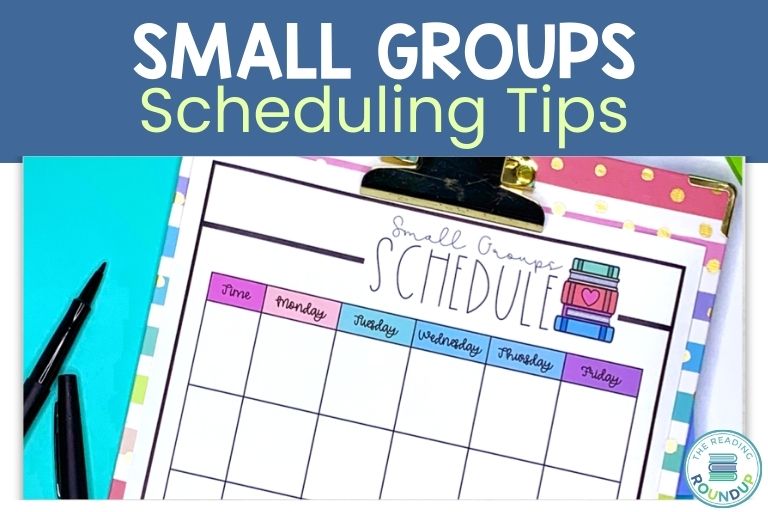
Before making your small group schedule, You’ll first need to determine how much time you can realistically work with reading groups each day. This will help decide a reasonable number of groups to work with daily. Ideally, you will need 15-20 minutes to meet with a reading small group. So if you have a 60-minute block for small groups, you may meet with 3 groups a day for 20 minutes each.
Use this information to determine your total number of slots for groups per week to make your small group schedule. So in the above example, you’d have 15 slots each week. Divide that number of slots between your groups based on needs.

Give priority to your lowest group by scheduling them every day. You may only meet with your highest groups once or twice a week, depending on your total number of groups and available time slots. Remember to pay attention to when students may be out of the room for other services when creating your small group schedule.
Here’s an example of how it may look with 15 weekly slots for 5 groups:
- Below Grade Level Group – 5x per week
- Bubble Group – 4x per week
- On Grade Level Group – 3x per week
- High On Grade Level Group – 2x per week
- Above Grade Level Group – 1x per week
Final Words of Encouragement
Realize that forming your small group schedule is not something you do one time and it is completely set for the entire year. Your reading groups will be continually changing based on students’ progress, schedule changes, or other unpredictable factors.
The most important thing is to commit to making your reading small groups a priority and protecting that valuable time as much as possible. As effective as whole group mini-lessons can be, students most benefit from the small group instruction at their individual levels!
To help you get started with creating your reading small group schedule, you can download a FREE sample of the forms shown in this post. Or you can click here to find additional forms for scheduling groups.

Want to Pin this for later?