The Beanie Babies Reading Strategies have made a tremendous impact on my students’ ability to successfully decode unknown words independently. Since I have found these reading strategies to be highly effective with my students, I want to share my tips with you to hopefully help your students find the same success!
If you’re unfamiliar with the Beanie Baby Strategies, you’ll want to start by checking out part 1 of this series where the strategies are introduced. You may also be interested in reading part 2 where I share steps for introducing the strategies to your students.
This post includes affiliate links for which I may make a small commission at no extra cost to you should you make a purchase.

Helpful Tips for Implementation
Tip #1: Search for Beanie Babies
Contact students’ families to ask if they have any of the Beanie Babies at home. Luckily, I was able to get the entire set of them that way! You may also want to check out Amazon, Ebay, or thrift stores to find yours. Currently, Amazon has Eagle Eye, Lips the Fish, Stretchy the Snake, Chunky Monkey, Skippy the Frog, Tryin’ Lion, and Flippy the Dolphin all available. Having the actual Beanie Babies is a key factor in their effectiveness.
Tip #2: Provide a Hands-On Approach
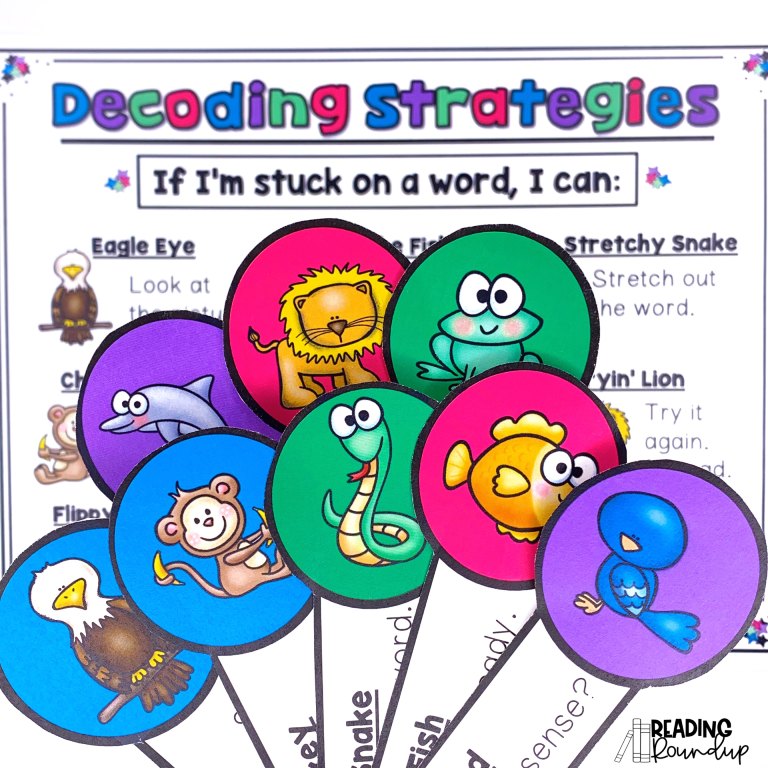
An important factor in the success of the strategies is to have a tool for the students to physically manipulate when they are stuck on a word. Even if you can’t find the actual Beanie Babies, I strongly recommend having something to represent each strategy. Another option is the strategy sticks as shown here. This adds a hands-on approach that helps students take more ownership of the strategy, thus enabling them to independently implement the strategy.
Tip #3: Review the Strategies
Begin each guided reading lesson with a quick review of the strategies previously taught. Ask the students to tell what they can do if they get stuck on a word. They must tell the strategy and not just the name of the Beanie Baby. Once students identify a strategy, I toss them the corresponding Beanie Baby. This simple warm up activity gets them excited to read and helps build their confidence that they will be able to figure out any unknown words they encounter.
Tip #4: Explain the Strategy Used
It is important to constantly have students explain the strategies to you. They must tell you the decoding strategy and NOT just the name of the Beanie Baby. For example – encourage them to say “I can stretch out the word,” not just “Stretchy Snake.” When they get stuck on a word, ask them to explain what they can try. If a student successfully implements a strategy to decode an unknown word, ask him/her to explain what they did. By having them orally explain the strategy to you they will begin to internalize it more.
Tip #5: Build Toward Independence
The Beanie Babies are just a scaffold. Once students can verbally explain the strategies and independently implement them, it is no longer necessary to use the visual and physical prompts to reminds students of the strategies. The posters may remain up all year for students to refer to, but as a result of the extensive work practicing the strategies at the beginning of the year, students will rarely need to refer to the posters.

Make sure you check out part 1 of this series to get a more in-depth introduction to all of the Beanie Baby Decoding Strategies! You may also want to read part 2 to find out steps for introducing the strategies
Science of Reading Update!
Since originally writing this post, current research advises against using decoding strategies such as the Beanie Babies. Instead, they are stressing the significance of systematic, explicit phonics instruction. Researchers also advise against the use of the 3 cueing systems. They state that these strategies teach students to guess the words rather than figuring them out phonetically.
As a result, I created new decoding strategies in alignment with the Science of Reading. These new decoding strategies encourage students to look at the word and apply phonics skills versus implementing guessing strategies such as looking at the picture to figure out a word. You might be interested in these new strategies as an alternative to the Beanie Babies!


Have you used these decoding strategies with your students or is there something else you’ve found to be more beneficial? Share your tips in the comments below!

Want to Pin this for later?