


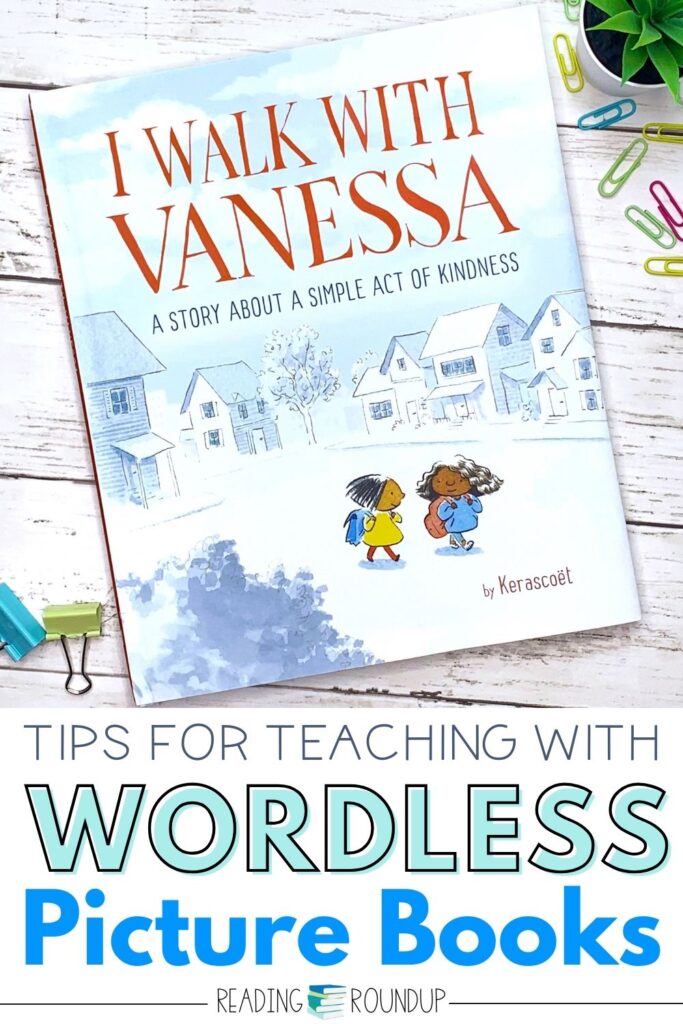


Teaching wordless picture books will open up your students’ imaginations and enhance their critical thinking skills. But yet with all the skills we can teach using wordless books, they tend to be underutilized in classrooms. Learn about engaging wordless picture book activities that will make you want to keep a set of them in your classroom library to use over and over again!
This post includes affiliate links for which I may make a small commission at no extra cost to you should you make a purchase.
What are Wordless Picture Books?
Wordless picture books are simply books without words. They rely on the pictures to tell the story. There are also some books that are nearly wordless books that use a few words and phrases to guide the plot along. Check out my favorite Wordless Picture Books.


Why Use Wordless Picture Books?
Wordless picture books naturally bring out students’ curiosity. They will automatically ask questions about the text and look at the details to infer what is happening.
Emergent and reluctant readers can feel successful as they can “read” these books without struggling to decode unknown words. Using wordless picture books with these students allows them to access higher-level comprehension than texts at their instructional reading level. It builds their reading confidence and independence!
Teaching Wordless Picture Books to Improve Reading Skills
You may be unsure of where to begin teaching wordless picture books in the classroom. These books are more versatile than people may think at first glance. The skills are not just limited to our youngest learners, upper elementary students can also practice skills with wordless books. There are many wordless picture book activities that teach multiple skills!
Storytelling
Encourage students to “read it like a story” rather than just describing the pictures. Make sure they include story elements as they read (setting, characters, conflict, resolution).

Prediction
As students are reading the book, they can make predictions of what they think might happen next. Make sure to encourage them to use evidence from the picture to support their predictions. This may be a detail in the picture that makes them think a certain way or connects to their background knowledge.
Once the book ends, ask them to predict what they think might happen if the story continues. You can also try a backward prediction where you begin the book in the middle or toward the end. Students can predict what they think already happened.
Inference
Wordless picture books are the perfect introduction to teach inference. Students will automatically make inferences as they try to figure out what is happening. Encourage them to use the evidence (picture clues) and their schema to make inferences.

Questioning
Students will naturally ask questions as they are reading wordless picture books. These questions assist them as they try to make sense of the story. Encourage them to consider the 5 W questions to identify story elements: Who is the story about, When/where does it take place, What is happening, and Why did the character ____?
Sequencing and Retelling
Use pictures from the book to have students sequence them in the correct order. They can also use the pictures to retell the Beginning, Middle, and End to a partner during literacy centers.

Writing
Students can add dialogue to the stories by making inferences about what they think the characters might be saying. Younger students can write speech bubbles on sticky notes while older students can use quotation marks. Or have them select one page and write what they think is happening.
Wordless picture books are also a perfect tool for teaching creative writing. Students can write what they think happened before the story started or will happen after it ends. Or if they’re feeling inspired they can write their own story!
Tools for Teaching Wordless Picture Books
While students can simply enjoy wordless picture books for fun, you may want to provide tools to make their reading more intentional. These tools will help you set a purpose for reading when teaching wordless picture books so students can practice specific skills.
Anchor Charts
Display anchor charts to remind students of their purpose for reading the wordless book. Maybe you want them to focus on the story elements. You might want them to practice making predictions and inferences or asking questions as they read.


See, Think, Wonder
The See, Think, Wonder strategy encourages students to think critically about the text and is perfect to use with wordless picture books. Students discuss or record the details they notice, their thinking about the images, and any questions they’re wondering.
Prompts and Sentence Stems
Ask students prompts as they are reading, to encourage them to expand on their thinking and increase their vocabulary. Have them elaborate on the pictures to explain what is happening in the story versus just describing the pictures.
- What is happening?
- Where do you think the story takes place?
- What do you think the character is thinking?
- How do you think the character is feeling?
- Why did the character make that choice?
- What might happen next?
When asking students these prompts it is important to have them support their thinking with evidence from the text. Provide sentence stems to guide their thinking.
- I think the story takes place ___ because ___.
- I think that the character is feeling ___ because ___.
- I think the character will ___ because ___.
Graphic Organizers
Provide students with a graphic organizer to complete during or after reading. This can be a simple activity for them to complete during centers.

Teaching Wordless Picture Books
Teaching wordless picture books can be done as a part of your reading minilesson, buddy reading during literacy centers, independent reading, or writing workshop. The options are limitless as so many skills can be taught with these books!
What wordless picture book activities have you implemented? What are some of your favorite wordless books to use? Share in the comments!
Want to Learn More?
You’ll love these related posts!


WANT TO PIN THIS FOR LATER?


